Laid-off Ohio mother, 52, reveals how she went from 214 rejected job applications to charging local businesses $500 a month - using the same AI everyone fears is 'coming for their jobs'
- Dana Whitfield, 52, was laid off after 22 years - then found her old job relisted at just $19 an hour
- She now runs a 'one-app agency' from her kitchen table with four businesses paying her monthly
- READ: The billion-dollar software company paying for women to learn the same system
PUBLISHED: 11:02 EDT, | UPDATED: 14:41 EDT,
 📷 +5 View gallery
Dana Whitfield, 52, at the Cincinnati kitchen table she now runs her business from. 'My commute is nine steps. My last one was 40 minutes each way for 22 years'
An Ohio mother of two who was laid off after 22 years - then watched her old job get relisted at $19 an hour - has revealed how she replaced her income in seven weeks using the same AI technology most Americans say they're afraid of.
Dana Whitfield, 52, from Cincinnati, was an operations manager at a regional insurance office until a Tuesday morning email ended her career in one paragraph.
The email misspelled her name.
'It thanked "Donna" for her contributions,' she told the Daily Standard. 'Twenty-two years, and they couldn't spell my name on the way out.'
Three weeks later, her position appeared on a hiring board with a new title. It was listed at $19 an hour.
'I sat in the school pickup line and did the math on what my life was worth to the market. The answer was: less than the girl at the drive-through makes with tips.'
What happened next has become quietly common among women over 45 - a group hit hardest by 'restructuring' and, according to hiring data, called back the least.
Whitfield sent out 214 job applications over six months. She received three human replies.
'The interviews were run by men my son's age,' she said. 'They kept asking if I was comfortable with fast-paced environments. Eventually I understood it was a question about my birth year.'
 📷 +5 View gallery
The box from her last day at the insurance office rode around in her car for a month. 'I couldn't bring it inside. Bringing it inside made it real,' Whitfield said
She tried the standard advice. A coding bootcamp took $12,900 of her severance; she quit in week two. Franchise brochures wanted $40,000 liquid to start the conversation. Her sister pitched a wellness company whose inventory is still stacked in a garage in Dayton.
DoorDash paid $11 an hour after gas. She lasted nine days.
'I wasn't unemployable. I was un-hireable,' she said. 'It took me six months to understand those are different things.'
The turn came from a former coworker - another woman 'impacted' in the same round of layoffs - who mentioned she'd started charging a local dentist $500 a month for something called an 'AI front desk.'
Whitfield assumed it was a scheme. Then the woman showed her the invoices.
What her friend had joined was a free training program built around a single idea: local businesses are bleeding money from three leaks - Google reviews they never answer, phone calls they miss during busy hours, and no-shows - and the software industry that could fix it has never bothered to explain it to them in English.
Software like Podium and Birdeye runs $400 to $900 a month and markets itself to people who already understand it. The gap, in other words, isn't technology. It's translation.
'The people positioned to close that gap aren't 24-year-old engineers. They're people the owner already trusts. The software industry can't manufacture trust. Middle-aged women walk in with it,' a growth manager at one AI platform told this website, speaking on background.
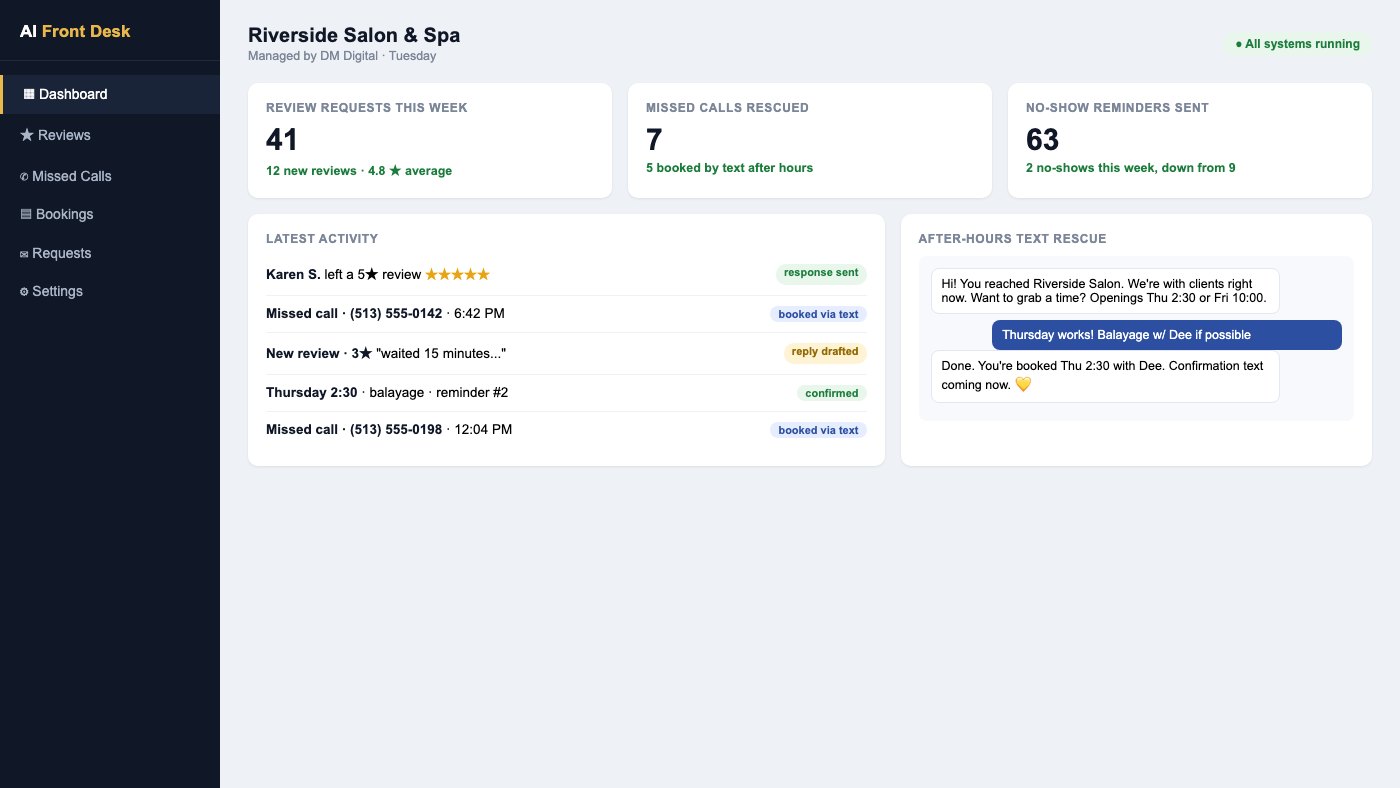
The program hands members a working app - an 'AI Front Desk' that requests and answers Google reviews, texts back missed calls and books them, and sends the reminders that kill no-shows - along with the outreach scripts and a 15-minute demo playbook for selling it to local businesses.
Members don't code anything. They clone a working template on Base44, the AI app-builder owned by Wix, and customize it by typing instructions in plain English.
 📷 +5 View gallery
Whitfield's cloned dashboard for her first client, a Cincinnati salon. Seven missed calls were rescued the week this website reviewed it - five booked by text after closing time
Whitfield cloned her first copy on a Sunday. It was live, with her name on it, in about 40 minutes.
'I kept waiting for the part where I'd need my nephew,' she said. 'It never came.'
On day four she sent her first eleven outreach messages, using the scripts, to businesses she already knew as a customer.
On day nine she ran her first demo - at her own hair salon, booked while getting her roots done. She showed the owner three unanswered Google reviews and what the app would have replied. The demo took 12 minutes.
On day eleven, the salon became her first client. $500 a month.
'I cried in the car. Then I drove home and cloned the app for the dry cleaner.'
 📷 +5 View gallery
The 12-minute demo, reconstructed at the salon where it happened. 'I showed her what her own missed calls were costing her. She got her card before I finished'
By week five she had a third client, and a fourth demo that no-showed her. 'That stung. I rebooked it for the following Tuesday.'
By week seven: four clients, $2,100 a month, recurring. One client later canceled after two months. She replaced them in eleven days.
For calibration, $2,100 a month is not wealth. It's also more than her old salary netted after the commute, the wardrobe and the parking garage - and it was built in seven weeks from a kitchen table by a woman the job market had formally repriced at $19 an hour.
US Money Picks
By signing up, you'll receive our newsletter as well as marketing emails. You can unsubscribe at any time.
The obvious question - the one Whitfield asked her former coworker - is why any of this would be free. The program, The Build Society, sold for $2,997 last year.
The answer, confirmed to this website by people familiar with the arrangement: Base44 pays for it.
The math is unglamorous. A software company can spend its budget on Instagram ads, or it can sponsor training that creates skilled, committed users who build real businesses on the platform and stay for years. Sponsored members cost less than advertising.
The platform underwrites a fixed number of seats each month. The training is free to the member. The only money a member spends is the software subscription itself - about $100 a month, the same tool Whitfield runs her whole agency on. One client covers it five times over.
August's cohort opened Monday. When the seats are gone, enrollment closes until the next funding cycle and the course returns to its paid price.
🔴 EXCLUSIVE READ MORE
Check if sponsored seats are still open for the August cohort - takes 30 seconds, a real person calls to set you up
Whitfield is not an isolated case, which is what makes this a story rather than an anecdote.
Marcia T., 55, spent 27 years in dental office management before being laid off in March. She now has two clients - both dentists she used to order supplies from. 'My old boss is now my client,' she said. 'I want that printed somewhere.'
Elaine R., 49, of North Carolina, still types with two fingers. 'The app part was honestly the easy part. The course is what taught me who to talk to and what to charge.'
Deb K., 58, of Arizona, said her husband assumed it was a pyramid scheme until the second payment cleared. 'There's no downline. Businesses pay you for a service. It's the oldest model there is, with new tools.'
Asked what she'd say to a woman staring down application number 215, Whitfield paused.
'The market already told you its price for your next 20 years. It put it in writing. Mine was $19 an hour. You're allowed to decline.'
Last month, her old company posted her job again - the third time in a year. Whitfield sent them her agency's pricing sheet through the website contact form.
They haven't replied. She says it was worth it anyway.
TRENDING
The teacher who quit mid-semester and now bills more than her old salary112k viewing now
Inside the 'kitchen-table capitalist' wave nobody has noticed91k viewing now
AI giant pays for women over 40 to join The Build Society66k viewing now
The opinions and stories expressed in the comments section are solely those of the individual users and do not represent or reflect the opinions, views, or positions of Daily Standard.
© 2026 Daily Standard. The story above is a dramatization drawing on composite experiences of program participants; names, employers, and identifying details have been changed or combined, and the persons depicted are not actual individuals. Earnings and client figures shown are illustrative of the specific composite scenarios described, are not typical, and are not a promise or guarantee of income. Most people who enroll in any business training make little or no money. Your results depend on your effort, market, and circumstances. Base44 is a product of Wix.com Ltd.; all trademarks belong to their owners.
TOP STORIES
EXCLUSIVE Laid off at 52 and billing $2,100 a month by week seven: inside the 'one-app agency' wave184k viewing
The three 'leaks' costing every Main Street business thousands a month - and who's getting paid to plug them96k viewing
The 12-minute salon demo that ends with a card on the counter, every time77k viewing
'Overqualified' is a birth-year question: what hiring managers admit off the record about workers over 4561k viewing
Why a billion-dollar software company would rather sponsor your training than buy another Instagram ad54k viewing
Bootcamps, franchises and the $40,000 'conversation starter': the reinvention industry, priced39k viewing
She sent her old employer her new pricing sheet. They still haven't replied35k viewing
'My old boss is now my client': the dental manager who flipped the org chart28k viewing
603 comments
Managed a medical office 19 years, got 'restructured' in April, and I did the thing this article says, I pulled up my own job posting from june. $17.50. SEVENTEEN FIFTY. for a job I did for 19 years and trained 2 people to do. I had to go sit outside. anyway I checked the seats, whats the worst that happens, its free
good for her. my daughter in law keeps sending me these things idk if its for me but the part about the salon got me, ive known my hairdresser 22 years
These articles always leave out the part where 90% of people never make a dime. Shes the exception not the rule
@RealistRik the article literally says most people who enroll in any business training make little or no money, its in the fine print. thats more honest than my old employer was. Also nobody said quit your job rick
The $19 an hour part made me put my phone down for a minute.
I sent this to my sister, she got let go from the bank in feb after 26 yrs... she cried at the severance email part. not in a bad way if that makes sense
@kwiltingkathy that detail came up in almost every interview for this piece, the way the layoff paperwork itself is the wound. Tell your sister the teacher story is worth her time too, it's linked above.
My wife did something like this with the dentist office she used to run. Everybody laughed. Shes billing more than my pension now so whos laughing
how long before the seats fill usually? asking for real not being sarcastic
@tiredofwinter I got mine week 1 of the july cohort, my friend waited and got waitlisted to august. so. dont be my friend lol